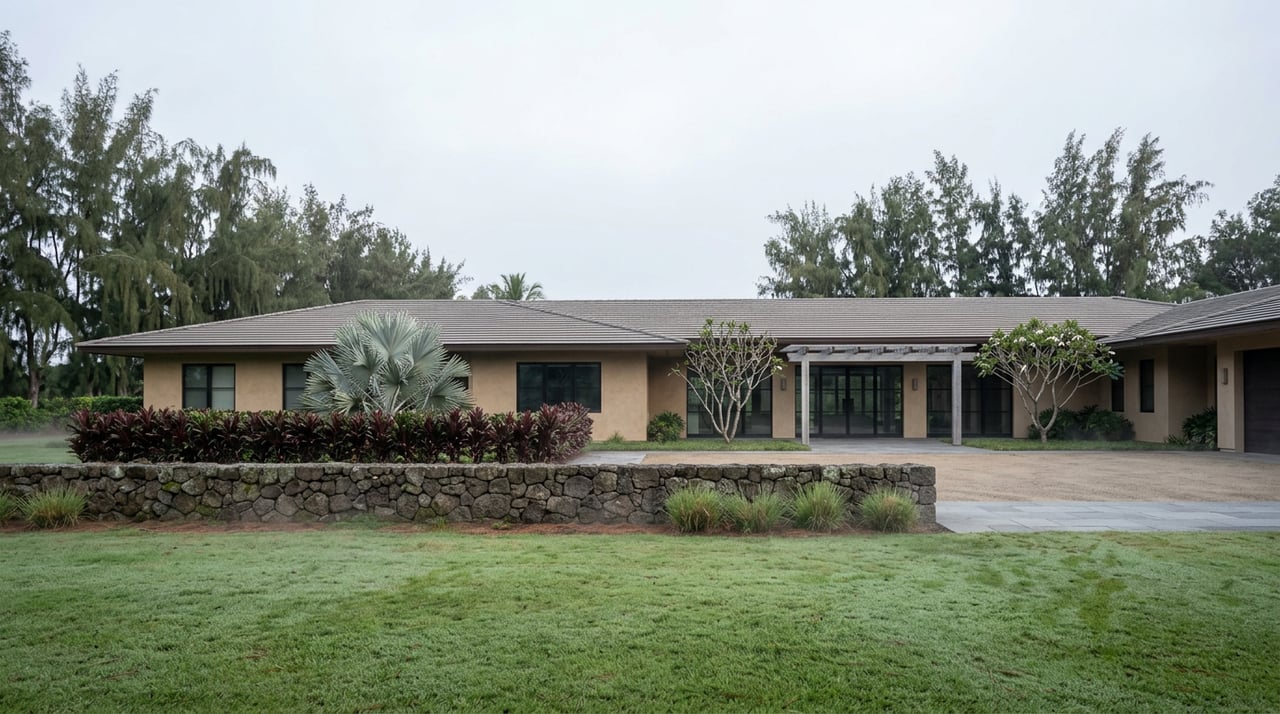
North Kohala Real Estate: Understanding Hawi Home Price Swings
Search "Hawi home prices" today and you'll find two numbers that tell different stories. One tracker shows the average North Kohala house down 72.8% from a year ago. Another shows Hawi's median sale price down 18.2% over the same stretch. If either number reflected a broad market trend, it would signal a major shift on the Big Island's west side.
Neither number is telling you what you think it's telling you. The real story isn't a falling market. It's a thin one, and understanding why changes how you should actually shop here.
North Kohala, the district that runs from Hawi through Kapaau and out into the ranch land toward Kohala Ranch, recorded just 22 residential sales over the trailing twelve months in one recent regional accounting. That's the entire district. Twenty-two closings a year works out to one or two new sales a month, in a market that stretches from modest plantation-era cottages to multimillion-dollar oceanfront ranch estates.
When a market that thin reports a month-over-month or year-over-year percentage change, you're not looking at a trend. You're looking at whatever two or three transactions happened to close in that window. Sell one $600,000 fixer-upper in July and one $3 million estate the following July, and the year-over-year "average" swings by a factor that has nothing to do with what land in North Kohala is actually worth. A single unusual closing can move the headline number more than an entire year of real appreciation or depreciation would.
A percentage on its own leaves out transaction context that matters in a thin market. In a market with hundreds of monthly sales, that shorthand is roughly fine. In a market with 22 sales a year, it's closer to reading tea leaves.
A Hawaii Life post on Hawi-to-Kapaau home sales provides context for this comparison. The most useful way to understand North Kohala pricing isn't the average at all. It's the spread. In the most recent full year of Hawi-to-Kapaau closings tracked by a longtime local agent, the least expensive listing on the market was a fixer-upper in the modest Ainakea subdivision asking $524,999. The highest closed sale that year was $5,750,000, for a home on 21 acres inside the gated oceanfront subdivision Ranch at Puakea. Between those two figures sits everything from small-acreage lots in Maliu Ridge, a subdivision of one-to-three-acre parcels near Hawi town, to ocean-view estates on 20 acres in Puuepa Ranch.
That's not a typo or an outlier. That's the market. A single "median home price" trying to describe both ends of that range is not a useful number, and treating it as one is how buyers end up either overpaying for a modest lot or walking away from a fair-priced estate because the headline figure didn't match what was actually on the ground.
Days on market tells a steadier story than price does here. In that same annual accounting, the median time to sale was 47 days, with a mean of 62 days, a gap that itself hints at a few slower-moving listings pulling the average up. That's a far more stable signal in a 22-sale market than any single-month price average, because timing data doesn't get distorted by one enormous or one unusually small sale the way an average price does.
Part of why the headline number fails buyers is that "North Kohala" isn't a single neighborhood. It's a district that contains at least four distinct sub-markets, each with its own pricing logic, and lumping them together is exactly how a $524,999 fixer and a $5.75 million estate end up in the same statistic.
| Sub-market | What defines it | Typical lot character |
|---|---|---|
| Hawi and Kapaau town | Plantation-era homes and small-acreage subdivisions like Maliu Ridge | Agricultural zoning, 1 to 3 acres, walkable to town |
| Kohala Ranch | Gated, elevation-tiered community spanning roughly 120 to 3,000+ feet | The Heathers (lowest, warmest, ocean views), the Meadows (mid-elevation, 3 to 5 acres), the Summit (highest, coolest, up to 10-plus acres) |
| Kohala Waterfront | Small, intimate gated oceanfront enclave | Limited to 50 residential lots, direct shoreline access |
| Puakea Bay Ranch | Gated equestrian community north of Hawi | Nearly four miles of riding and walking trails, larger acreage parcels, county water |
Kohala Ranch alone illustrates the point. Its three tiers, the Heathers, the Meadows, and the Summit, sit at different elevations and carry different climates, view corridors, and price expectations. A Heathers lot near sea level with unobstructed ocean frontage is not competing for the same buyer as a Summit parcel a thousand feet higher with cooler air and denser greenery. Both get counted under the same "North Kohala" umbrella in a portal's monthly snapshot. Neither one is representative of the other.
The practical takeaway is that comparing "Hawi prices" to anywhere else on the island, or even to last year's Hawi prices, only works if you specify which of these four sub-markets you mean. A buyer comparing a Kapaau plantation cottage to a Kohala Waterfront estate isn't comparing apples to apples. They're comparing two different products that happen to share a zip code.
The thinness of this market is the story. Twenty-two sales a year means the headline number may reflect just the last two or three deals that happened to close, rather than a broader trend.
Most parcels in the Hawi and Kapaau area carry agricultural zoning, a detail that matters well beyond the closing table. Ag zoning is part of why small-acreage subdivisions like Maliu Ridge feel private rather than crowded. A one-to-three-acre ag lot gives room for a garden, a few animals, or simply distance from the next house, without the density that a standard residential subdivision would carry. It's also why land use questions here are worth raising early with a knowledgeable agent rather than assumed. What a buyer can build, plant, or keep on an agriculturally zoned North Kohala parcel is a different conversation than it would be on a standard house lot in a resort subdivision.
There's a community dimension to this too. Housing here has been tight enough, for long enough, that a nonprofit called the Kohala Community Land Trust exists specifically to help keep a share of the district's housing stock permanently affordable for local residents, alongside supporting agricultural and small commercial enterprises. Two small-scale affordable housing developments have been working through infrastructure and permitting in the district. None of that shows up in a monthly price average either, but it's part of what makes North Kohala a place with a working ranch-town economy underneath the luxury listings, not just a resort adjacent to one.
If you're comparing North Kohala to Waimea, Mauna Lani, or Waikoloa, the honest starting point is that North Kohala's headline numbers are the least reliable of any Kohala Coast sub-market, simply because there are so few transactions to average. That's not a reason to avoid the district. Land here, particularly the large-acreage, gated, ocean-view parcels in Kohala Ranch and Puakea Bay Ranch, competes with Kona-level pricing while offering a fraction of the inventory turnover, which is exactly why patient buyers who move quickly when the right listing appears tend to do well here.
The better questions to ask before making an offer aren't "what's the median" but "what sub-market am I actually in, and what closed recently in that specific pocket." A Heathers estate, a Summit lot, a Kapaau cottage, and a Kohala Waterfront parcel each deserve their own comparison set. Days on market in that specific pocket will tell you more about competitiveness than any district-wide average.
Is North Kohala a buyer's market or a seller's market right now? Neither label fits cleanly. With roughly 22 sales a year across the whole district, there isn't enough volume for a single market condition to apply everywhere. A well-priced Kapaau cottage and a Kohala Ranch Summit lot can be moving at completely different speeds at the same time.
Why do some North Kohala listings mention a private water company? Kohala Ranch, in particular, is served by a private water utility rather than county water, which is worth understanding before comparing carrying costs to a home in a county-serviced neighborhood.
What's the real difference between Kohala Ranch and Puakea Bay Ranch? Kohala Ranch is the larger, elevation-tiered community with three distinct zones from near sea level up to roughly 3,000 feet. Puakea Bay Ranch is a smaller, equestrian-focused gated community built around riding and walking trails, closer to Hawi town.
Does agricultural zoning limit what I can do with the property? It shapes what's typical and expected on the land, from garden and small-animal use to overall density, and it's a detail worth discussing directly with an agent who knows the specific parcel before assuming anything.
If you're weighing North Kohala against another stretch of the Kohala Coast, or trying to figure out which of its sub-markets actually fits what you're picturing, Deborah Thompson can walk you through what's really moved here recently, parcel by parcel, not just the headline number. Let's Connect.
This article is general information, not legal, tax or financial advice. Consult a qualified professional about your situation.
Deborah derives great satisfaction from fulfilling clients' aspirations by connecting them with their ideal homes. She endeavors consistently to cater to the requirements of both buyers and sellers.
DEBORAH THOMPSON
65-1279 KAWAIHAE RD SUITE #104 KAMUELA HI 96743