Kailua-Kona Condo HOA Fees and Insurance: What Buyers Miss
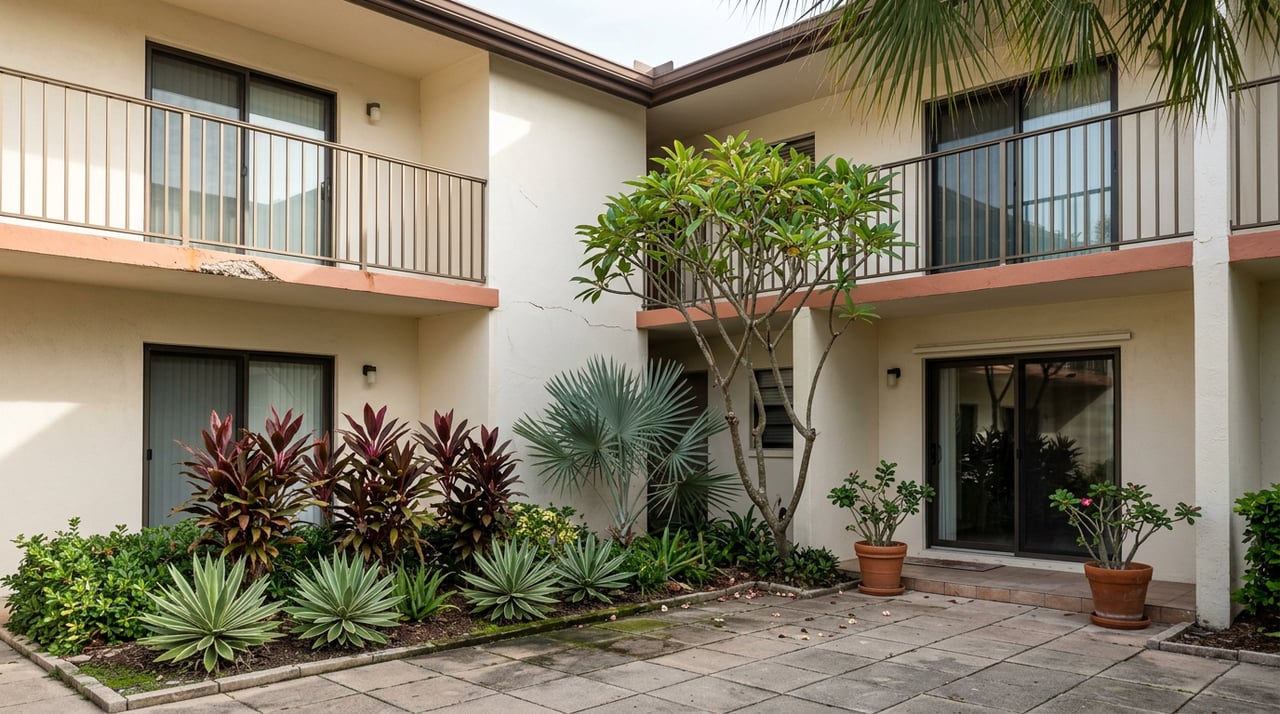
Walk along Alii Drive this summer and you will hear Kona Reef before you see it. Scaffolding wraps entire stacks of units, jackhammers run on weekday mornings, and lanais sit temporarily off limits building by building. The complex started a structural and resurfacing project in January 2026 that runs through September, addressing water damage, corrosion, and deferred maintenance that had been quietly accumulating for decades. It is not a cosmetic refresh. It is the bill for forty years of salt air finally coming due.
A few miles down the same stretch, Alii Cove began its own spalling repair project that same January, with two contractors moving through 35 buildings on staggered schedules. Neither project is an outlier. It is what happens to oceanfront concrete built between the early 1970s and mid-1990s, which describes most of Kailua-Kona's condo stock, once the underwriting math finally catches up with the calendar.
That timing matters right now, because the headline number in Kona's condo market is telling buyers a much simpler story than the one actually playing out.
Year to date through mid-2026, Kailua-Kona's median condo price has fallen to $570,000, down 12.3 percent from a year earlier and back to levels last seen in 2023, after the market peaked near $694,000 in April 2025. Months of supply now sit at 7.7, firmly in buyer's market territory, with roughly ten active listings for every one that goes pending.
Read on its own, that looks like a straightforward window: prices are down, inventory is up, take your pick. But the units pulling that median lower are not interchangeable except for price. Two condos can list within a few thousand dollars of each other and carry very different real costs of ownership, and almost none of that difference shows up in the listing description.
Hawaii routinely ranks among the cheapest states in the country for homeowners insurance, with the average policy running around $101 a month, a fraction of mainland rates. That statistic is close to irrelevant for a Kona condo buyer, because it describes a typical single-family policy, not the master policy an association carries on a concrete oceanfront building built before 1995.
State insurance regulators have laid out why that master policy is a different animal. Only a handful of insurers currently write master hurricane policies for Hawaii condos, and many now cover just 20 to 30 percent of a building's total replacement exposure, which forces associations into the surplus lines market for the rest, at rates the state has no authority to regulate.
That gap has a financing consequence buyers rarely think to ask about.
Fannie Mae and Freddie Mac require full building coverage for hurricane risk before they will purchase a mortgage written on a unit there. Because primary lenders resell roughly seventy percent of their loans to those two entities, a building that cannot secure full coverage effectively becomes a cash-only market.
That is one honest explanation for part of Kona's falling median. It is not that oceanfront property got less desirable this year. It is that some of it got harder to finance, which mechanically shrinks the buyer pool down to cash buyers and quietly caps price growth in specific buildings, regardless of what demand is doing across the wider market.
Kailua-Kona's AOAO fees typically run $700 to $1,400 a month, covering exterior insurance including hurricane coverage, water and sewer, common area landscaping, and pool maintenance. Oceanfront buildings and older complexes facing salt-air maintenance and reserve catch-up tend to sit at the top of that range.
Kona's condo inventory runs from direct-oceanfront towers like Kona By The Sea and Kanaloa at Kona down to mid-size garden complexes like Casa De Emdeko, built in 1970, and Sea Village, built in 1974 with 132 units spread across five buildings. Most of Alii Drive's roughly 40-to-200-unit complexes share that same 1970-to-1995 construction window, which means a large share of Kona's condo stock is approaching, or already past, the point where major building systems reach the end of their useful life at roughly the same time. State regulators specifically flag pipes, windows, concrete, decks, and railings as the components most likely to trigger an assessment once a building crosses that forty-year mark.
| Building profile | Where the AOAO fee typically lands | What usually drives it |
|---|---|---|
| Smaller or recently renovated complex, current on its reserve study | Lower end of the $700–$1,400 range | Master policy closer to full replacement coverage, no active special assessment |
| Older oceanfront building mid-repair or recently non-renewed | Upper end of the range, often plus an assessment | Salt-air corrosion, aging plumbing or concrete, surplus lines coverage |
Neither profile is visible from a listing photo. Both are visible in the association's documents, which is exactly where the real comparison shopping has to happen.
The pressure behind these numbers did not start this year. Beginning in 2023 and accelerating through 2024, Hawaii condo associations statewide saw one-year master policy premium increases of 300 to 600 percent, four to seven times the prior year's cost, with a handful of buildings seeing jumps of 900 to 1,300 percent. Much of that spike traced back to international reinsurance costs rather than local risk alone. Hawaii has more than 1,000 residential condo buildings, and many simply could not absorb the new premiums, leaving a growing number underinsured.
Kona got its own reminder of how fast this can move. In March 2026, a Kona low weather system generated enough property claims that the state's insurance commissioner issued an emergency declaration allowing temporarily licensed out-of-state adjusters to help process them, a sign of how quickly one storm season can strain the local claims pipeline.
Projects like Kona Reef's and Alii Cove's are underway. Insurers increasingly want proof of repair before renewing coverage or restoring full replacement limits.
Governor Josh Green signed Senate Bill 1044, now Act 296, on July 8, 2025, reactivating the Hawaii Hurricane Relief Fund for the first time since the 1990s and expanding the Hawaii Property Insurance Association. In May 2026, the state opened a companion condominium loan program to help associations finance roofing, piping, fire safety, and other repairs at more favorable rates than the open market offers.
Two details matter more than the headline. First, an association has to meet an eligibility requirement before it can apply for the reactivated relief fund. Second, the loan program has eligibility requirements.
A softer median gives Kona buyers real leverage in 2026, but only if the comparison goes past the list price. Before treating a lower number as a bargain, ask for:
Does a lower price per square foot in Kona always mean a better deal? Not on its own. Kona's condo market trades on relatively few monthly transactions, so a single month's median or price-per-square-foot figure can swing on sales mix alone. Building-level detail, age, insurance status, and reserve health, usually tells you more than one headline number.
What is the difference between the building's master policy and my own condo insurance? The master policy, funded through your AOAO fee, covers the building's exterior and common areas. Your personal HO-6 policy covers your unit's interior and belongings, and insurance comparison sites currently put the average Hawaii HO-6 premium around $595 a year. That number has nothing to do with what your monthly AOAO fee is absorbing on the building side.
If a building's insurer won't renew, what actually happens next? The association typically moves to surplus lines coverage in the interim, priced without state rate oversight, while it works to meet the eligibility requirements for the reactivated Hawaii Hurricane Relief Fund.
Will the new state loan program bring AOAO fees down right away? Not immediately. The program is designed to help associations finance the repairs, roofs, pipes, fire safety systems, that make a building insurable again. It is a multi-year fix aimed at restoring coverage, not a direct subsidy on this month's maintenance bill.
A lower median gives Kona buyers room to negotiate this year that has not existed in some time. The buyers making the best use of that room are the ones asking about reserve studies and master policy coverage before they fall for a number on the listing sheet. If you want a second set of eyes on what a specific building's documents actually say about its insurance and repair history, Deborah Thompson works through exactly this kind of comparison with Kona buyers every week. Let's Connect.
This article is general information, not legal, tax or financial advice. Consult a qualified professional about your situation.
Deborah derives great satisfaction from fulfilling clients' aspirations by connecting them with their ideal homes. She endeavors consistently to cater to the requirements of both buyers and sellers.
DEBORAH THOMPSON
65-1279 KAWAIHAE RD SUITE #104 KAMUELA HI 96743