Buying Acreage in Hawi Kohala: What to Review First
Buying acreage in Hawi can feel like finding the Big Island dream: open space, wide skies, and room to create something that fits your life. But rural land in North Kohala comes with questions that are easy to miss if you are focused only on the view or the size of the parcel. If you are considering acreage in Hawi, this guide will help you look past the dream and focus on the details that matter most before you buy. Let’s dive in.
Acreage in Hawi is not the same as buying in a typical subdivision. Utilities, access, land use, and site conditions can vary from parcel to parcel, even when properties are close together.
That is part of what makes North Kohala so appealing, but it also means your due diligence needs to go deeper. Before you move forward, you will want to confirm how the land actually functions, not just how it looks on paper.
One of the first things to understand about Hawi acreage is that conditions can shift quickly across short distances. According to the National Weather Service, Hawaiʻi’s mountains create strong microclimate differences, with wetter windward slopes and sunnier, drier leeward areas.
For you as a buyer, that means one parcel may feel lush and green while another nearby may feel drier, windier, or more exposed. Elevation, slope, and orientation all affect how a property lives day to day, so it is worth visiting the land at different times if possible.
Hawi sits within Kohala, which the USGS places in lava-flow hazard Zone 9, the least hazardous zone on Hawaiʻi Island. Kohala has not erupted for tens of thousands of years, so lava-flow risk is lower here than in younger parts of the island.
That said, lower lava risk does not mean you can skip hazard review. Wildfire, flooding, drainage, and coastal exposure can still affect rural parcels, and those issues may have a more direct impact on your use of the land.
Wildfire is a real consideration in North Kohala. In October 2025, the County of Hawaiʻi issued a burn ban during a Red Flag Warning that covered North Kohala, showing that critical fire-weather conditions can affect the area.
If you are buying acreage, ask practical questions early. Look at brush conditions, defensible space, access for emergency vehicles, and whether there is a dependable water source available for fire protection.
On rural property, water is often the first utility issue to verify. The County’s 2024 North Kohala water quality report says the North Kohala Water System normally draws from Hāwī Well Nos. 1 and 2 and the Halaula Well, and a completed 2023 project added a new well, a 500,000-gallon reservoir, more than two miles of waterline, and other improvements to increase capacity, redundancy, and reliability.
That is encouraging, but you should still confirm water service on a parcel-by-parcel basis. Do not assume that every acreage property has the same connection, meter status, or day-to-day reliability as a more urban neighborhood.
The Department of Water Supply has issued North Kohala notices when power outages limited pumping. In one 2025 notice, DWS explained that pumping equipment relies on Hawaiian Electric power and cannot operate during an outage.
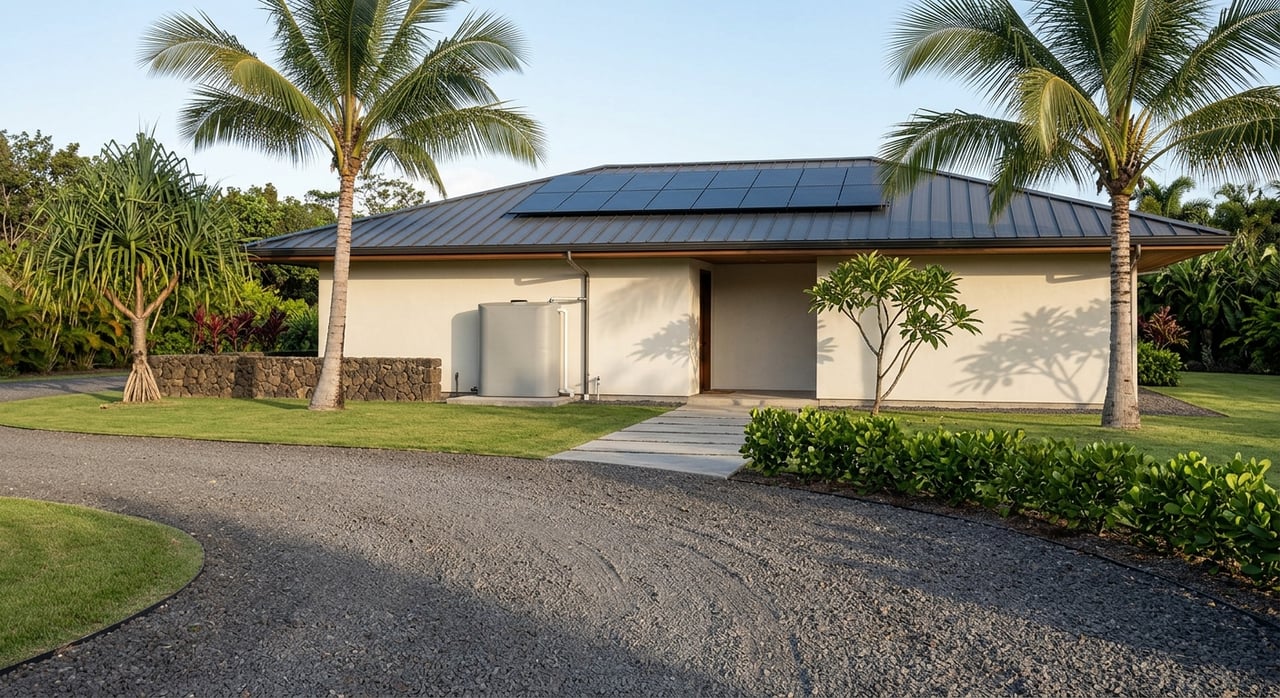
For you, that is a reminder to ask how the property handles interruptions. Even if a parcel has county water, it may still make sense to understand storage, irrigation setup, and contingency planning.
Rainwater catchment is also part of the local picture. The Hawaiʻi Department of Health says individual-home rainwater catchment systems are not regulated by DOH, but they should be well designed, maintained regularly, and tested periodically.
If a property uses catchment, ask how old the system is, how it is filtered or treated, and whether the water has been tested. DOH recommends testing for E. coli, turbidity, lead, and copper, which makes maintenance history especially important.
Wastewater is another key item that should be confirmed before closing. The Hawaiʻi Department of Health says that if a building is not serviced by a county or private sewer system, it has an onsite wastewater system.
On rural acreage in Hawi, that often means septic or another approved onsite system. You should also confirm whether an older cesspool arrangement exists and verify permit status as part of your review.
The North Kohala water quality report lists septic tanks, cesspools, injection wells, residential parcels, waste transfer stations, and diversified agriculture among activities that source-water assessments found could potentially affect the system. That does not mean a specific property has a problem.
It does mean utility layout and land use history matter. When you are evaluating acreage, it is smart to understand where wastewater systems are located and how the land has been used over time.
Large land does not automatically mean unlimited options. Hawaiʻi County Planning says Chapter 25 is the County’s zoning code, and it defines permitted land uses within the State Land Use Urban and Agricultural classifications while also setting standards like setbacks and height limits.
In practical terms, two acreage parcels can offer very different possibilities. If you are hoping to build, expand, farm, or add additional structures, zoning needs to be reviewed closely before you make assumptions.
County code shows that agricultural districts may allow uses such as crop production, farm dwellings, single-family dwellings, and livestock production, but some uses require additional approvals. The code also identifies minimum-acreage designations such as A-10a, which means a ten-acre minimum building-site area.
FA districts allow a different mix of farm and residential uses. Depending on the parcel and the intended use, some plans may require a use permit, special permit, or other approval.
The County Planning Department’s land-use permit materials list several approvals that can matter for rural property. These include an Additional Farm Dwelling Agreement, an Ohana Dwelling Permit, a Special Permit for certain non-agricultural uses on agricultural land, a Use Permit for certain non-residential uses on residential land, a Change of Zone, and a State Land Use Boundary Amendment.
That matters if you are buying with a longer-term vision. Before you fall in love with an idea for the property, make sure the approval path matches what you want to do.
A beautiful parcel can become much less simple if access is unclear or expensive to improve. Hawaiʻi County Code Chapter 22 says no County street may be used for ingress or egress without a properly located and constructed driveway approach, and landowners are responsible for maintaining and repairing driveway approaches at their own expense.
That means you should ask whether access comes from a County road, private road, shared driveway, or easement. You should also confirm who maintains it and whether any upgrades may be needed.
If a parcel needs driveway changes, utility trenching, drainage work, or road widening, permits may come into play. The County’s public works information provides a right-of-way permit path for work in public rights-of-way.
For buyers, this is less about paperwork and more about planning. If access work is needed, you want to know that before closing, not after.
Hazard checks should be part of every Hawi acreage purchase review. The County of Hawaiʻi provides interactive hazard maps, including a Hazard Impact Map and a Volcano Hazard Map, and FEMA’s Flood Map Service Center is the official public source for flood-hazard information.
Even if a parcel looks dry, drainage and overland flow can still affect large rural lots. This is especially important near gulches, drainage channels, or lower-lying areas.
If the acreage is near the coast, shoreline conditions deserve extra review. County shoreline-access materials for North Kohala note seasonal high surf, strong currents, hazardous shorebreak, and slippery rocks in coastal areas.
This may not affect every buyer, especially for more inland parcels. But for mauka-makai properties or land with expectations of shoreline use, it is worth understanding how coastal conditions could shape access and safety.
If you are narrowing down acreage options in Hawi, keep your first-pass checklist simple and practical:
The goal is not to make rural land feel complicated. It is to help you buy with clarity, so the property you choose supports both your plans and the realities of the site.
If you are considering acreage in Hawi and want a thoughtful, detail-oriented perspective on North Hawaiʻi real estate, Deborah Thompson offers hands-on guidance grounded in local market knowledge and personalized service.
Deborah derives great satisfaction from fulfilling clients' aspirations by connecting them with their ideal homes. She endeavors consistently to cater to the requirements of both buyers and sellers.

DEBORAH THOMPSON
65-1279 KAWAIHAE RD SUITE #104 KAMUELA HI 96743